
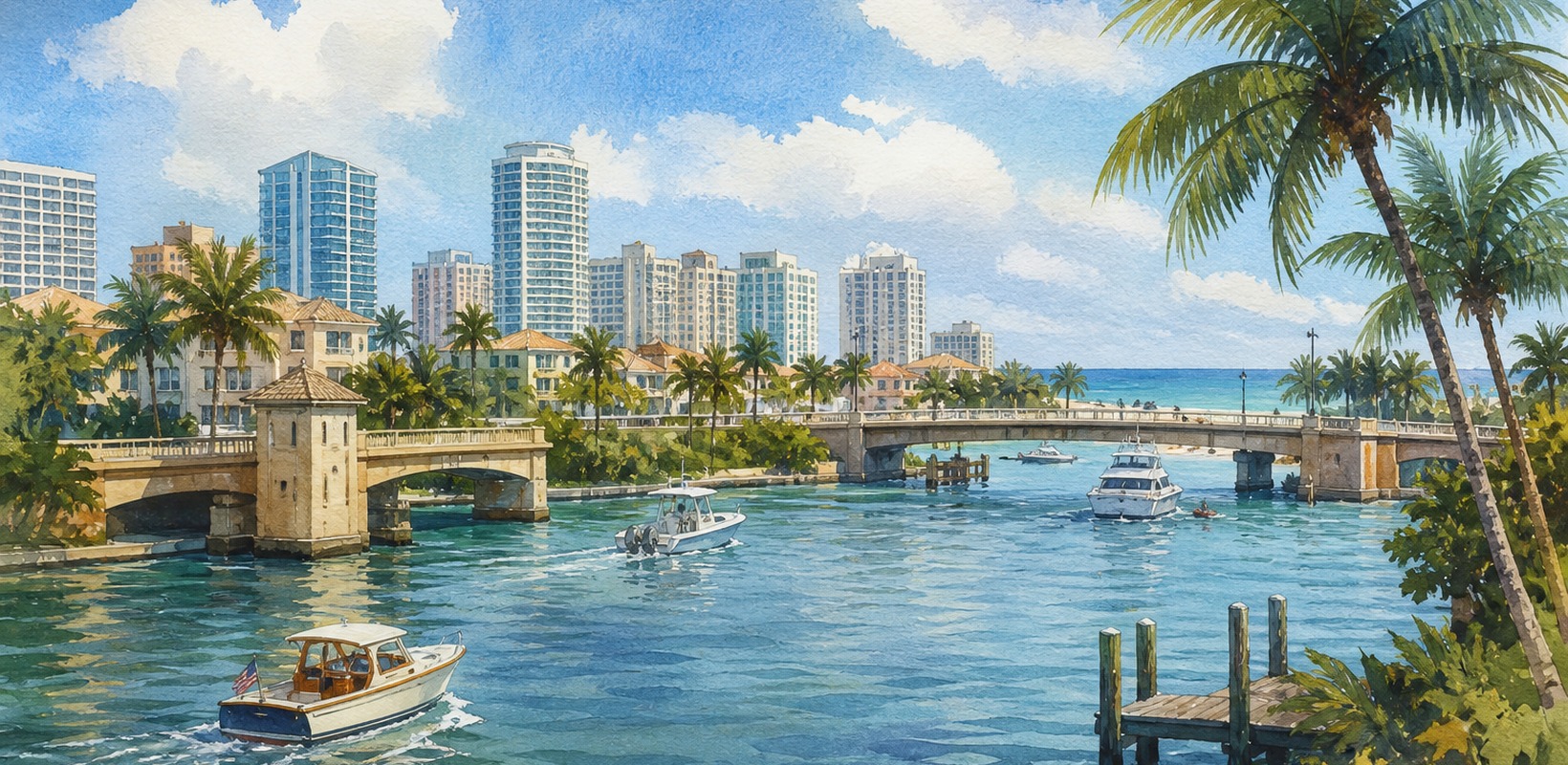
Broward County is often pictured as a strip of beaches and high-rises, but most of its map looks nothing like that. County planning figures put the total land area at about 1,225 square miles, with roughly 797 square miles set aside as conservation area. In other words, the dense urban county that nearly two million people call home is also mostly Everglades by area. The developed communities occupy the eastern side, packed between protected wetlands and 24 miles of Atlantic shoreline.
Fort Lauderdale is the county seat and the best-known city, famous for the New River, canals, boating and a downtown that has grown far beyond its spring-break reputation. Hollywood has its broad beach promenade and historic central streets. Pembroke Pines and Miramar anchor the southwest, while Coral Springs and Parkland sit farther north and west. Pompano Beach, Deerfield Beach, Lighthouse Point and Lauderdale-by-the-Sea line the coast. Plantation, Sunrise, Davie, Cooper City and Weston spread across the interior. Hallandale Beach, Dania Beach, Coconut Creek, Margate, Tamarac and the smaller cities each add another layer. Broward counts 31 municipalities, which makes a simple mailing address a poor guide to every jurisdictional question.
The population has continued to grow and diversify. Broward County's planning division reports a 2025 estimate just under two million residents, up from 1,944,375 in the 2020 Census. Fort Lauderdale, Pembroke Pines and Hollywood are the three largest cities in the county's current quick-facts table. Growth today is less about endless westward expansion than about redevelopment, infill and denser projects near established corridors. The Everglades conservation boundary makes the western edge quite literal.
That scale produces almost every kind of Florida deed. There are condominium units overlooking the ocean, single-family homes in western planned communities, duplexes in older neighborhoods, warehouse parcels near major highways, marina properties, shopping centers and redevelopment sites. A deed may follow a sale, gift, divorce, marriage, estate plan, trust transfer, business reorganization or correction. The right instrument depends on the circumstances, but the recording destination depends on the land: deeds affecting Broward County property are placed in Broward County's Official Records.
Broward has an important administrative difference from most Florida counties. The Clerk of Courts is not the office that records deeds. Recording is handled by Broward County's Records, Taxes and Treasury Division, Recording Section, at the Broward County Governmental Center. The division's own deed guidance says it records official documents, maintains the searchable database and provides certified copies. Court filings that are not recordable final judgments remain with the Clerk of Courts, so choosing the right records office matters.
The main recording counter is in Room 114 at 115 South Andrews Avenue in downtown Fort Lauderdale. Documents may be presented in person, mailed with payment and a self-addressed stamped envelope, or eRecorded through an approved third-party vendor. The county advises that mailed deeds normally take several business days to process and recommends in-person delivery when timing is critical. Staff can explain recording requirements and fees, but they cannot select or complete a deed or give legal advice.
The county publishes a base recording fee of $10 for the first page and $8.50 for each additional page. An instrument with more than four indexed names adds $1 for each additional name. Documentary stamp tax on deeds outside Miami-Dade County is generally $0.70 per $100 of consideration, rounded as required. Broward's fee page also lists accepted payment methods and a calculator. Because the total can depend on consideration, page count and indexing, the safest approach is to calculate it using current county instructions before submitting.
Broward's online Official Records index covers documents from 1978 forward, with images for more recent records and older material available through the Search and Copy Section. The county says certified copies and documents relating to real estate ownership are available back to 1883. A search generally begins with an owner name. If that is unknown, the Broward County Property Appraiser's site can be searched by address to identify the owner and folio number. The appraiser's parcel record is useful, but it does not replace the recorded deed, legal description or title work.
Local geography deserves special attention. A property marketed as Fort Lauderdale may actually be in another municipality or an unincorporated pocket, and a postal city can differ from legal municipal boundaries. None of that changes the county recorder. Property in Hollywood, Weston, Pompano Beach or any of the other Broward municipalities is still recorded in the same countywide Official Records system. Municipalities may maintain separate building, code or lien information, so a thorough transaction can involve more than one public database. That countywide system matters in a place where a short drive can cross several city limits before lunch, while every resulting deed still enters one records index.
Broward is crowded, fast-moving and remarkably varied, yet its recording rule is refreshingly simple. First identify the parcel and review the existing recorded documents. Prepare and execute the appropriate deed under Florida law. Then deliver it, with the correct fees and taxes, to Broward County's Recording Section. From an oceanfront condominium to a quiet cul-de-sac near the conservation area, that final public step puts the ownership change where future researchers can find it.
Official Records
Where deeds are recorded in Broward County
| Detail | Recording information |
|---|---|
| Recording authority | Broward County Records, Taxes and Treasury Division |
| Department | Recording Section |
| Main recording office | 115 S. Andrews Avenue, Room 114, Fort Lauderdale, FL 33301 |
| Mailing address | Records, Taxes and Treasury Division, P.O. Box 14668, Fort Lauderdale, FL 33302 |
| Telephone | 954-831-4000 |
| Submission | In person, by mail with a self-addressed stamped envelope, or through an approved third-party eRecording vendor. |
| Standard charges | For a standard letter-size instrument, Florida's statutory charges generally total $10 for the first page, $8.50 for each additional page, plus $1 for each indexed name after the first four. Deed documentary stamp tax is generally $0.70 per $100 or part of $100 of consideration. Tax, extra documents, certified copies and vendor charges can change the total. |
| Official Records | Search recorded documents |
| Property records | Open the county property appraiser |
Preparing the instrument
Deed requirements for Broward County
Florida law generally requires a deed conveying real property to be signed by the grantor in the presence of two subscribing witnesses. The instrument also needs the parties, legal description, consideration and documentary stamp treatment, acknowledgment, preparer information, return address, and printed witness information required for the particular recording.
For Broward County, the recorder currently describes submission this way: In person, by mail with a self-addressed stamped envelope, or through an approved third-party eRecording vendor. Posted standard charges are: For a standard letter-size instrument, Florida's statutory charges generally total $10 for the first page, $8.50 for each additional page, plus $1 for each indexed name after the first four. Deed documentary stamp tax is generally $0.70 per $100 or part of $100 of consideration. Tax, extra documents, certified copies and vendor charges can change the total.
The clerk records documents that satisfy its intake requirements but does not decide whether a deed produces the intended ownership, homestead, tax, mortgage, or estate-planning result. Review the current deed and transfer plan before signing. See Florida Statutes section 689.01 (opens in a new tab) for the statewide conveyance rule.
Recording places a deed in the county's public records, but it does not replace attorney review of the deed, title, homestead, tax or signing issues.
Sources and verification
- Broward County Recording SectionCorrect county recording authority, record types and in-person, mail and eRecording submission methods.
- Broward County Recording Your DeedDeed-recording requirements, database coverage, staff limitations and relationship to the Property Appraiser.
- Broward County Fee ScheduleRecording fees, documentary stamp tax rate and accepted payment methods.
- Broward County Recording OfficesMain Recording Office address, room and phone number.
- Broward Demographics Quick FactsLand area, conservation area, municipality count, population and largest cities.
- Broward Population and Forecasts2020 Census count and 2025 population estimate.
- Broward Wetlands HistoryApproximately two-thirds of the county is set aside as water conservation area and remains part of the Everglades.
- Florida Statute 28.24, clerk recording chargesState recording charge framework.
- Florida Department of Revenue, Documentary Stamp TaxDeed tax rates and Miami-Dade distinction.
General information only. This article is not a substitute for legal advice about a particular property or transfer.