
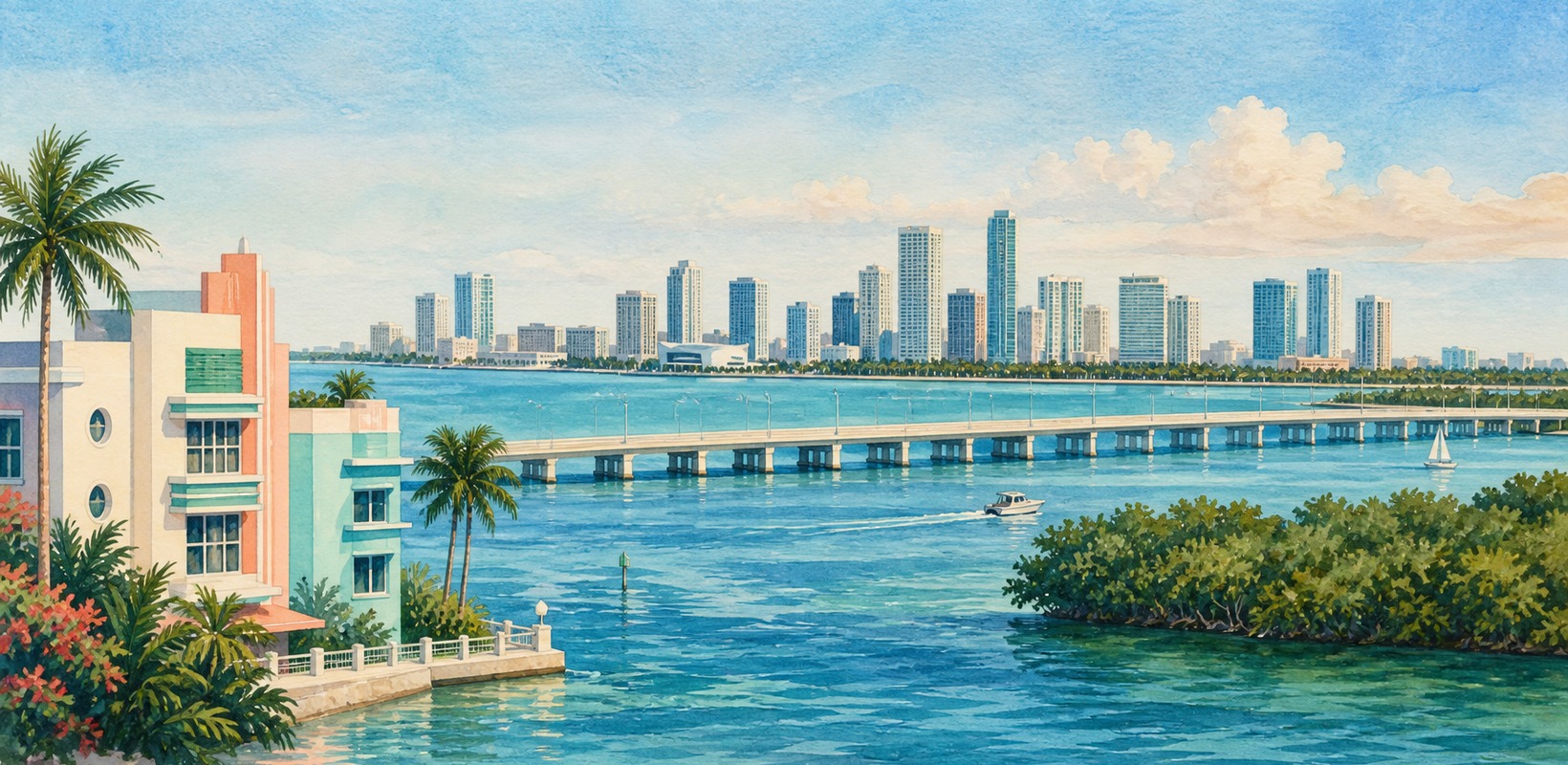
Miami-Dade County is one of the few places where a morning can begin in an Art Deco district and end beside crocodile habitat, coral reefs or an agricultural field. South Beach's pastel hotels form one of the world's best-known concentrations of twentieth-century resort architecture. The National Park Service credits preservation campaigns and a carefully developed color palette with helping save the district from demolition. It is cheerful evidence that paint can be serious civic business.
The county stretches far beyond Miami Beach. Biscayne National Park is about 95 percent water and protects islands, bay, mangroves and part of the Florida Reef. Everglades National Park begins along the county's western and southern edge. Between those national parks lies an urban region of 34 municipalities, large unincorporated communities, airports, ports, universities, industrial districts and some of the nation's most productive subtropical farmland. Few counties ask mangroves, high-rise towers and avocado groves to share one map.
Miami-Dade's natural floodplain is working infrastructure as well as scenery. County guidance explains that wetlands and coastal systems store water, filter pollutants and provide wildlife habitat. Those functions matter to development, drainage and insurance discussions, even when a parcel is miles from the postcard beach. Here, dry-looking ground can still belong to a larger water story.
Miami is the county seat and the center of the region's skyline, finance and international trade. Hialeah is a large, densely settled city with a strong Cuban-American identity. Miami Gardens, Miami Beach, Homestead, North Miami, Doral, Coral Gables and North Miami Beach are substantial cities with distinct housing and business patterns. Aventura and Sunny Isles Beach are known for condominium development. Cutler Bay and Palmetto Bay face Biscayne Bay, while Florida City sits at the mainland gateway to the Keys. Kendall, Westchester and other major unincorporated areas are local places even without their own city halls.
The Census Bureau estimated 2,802,029 Miami-Dade residents in 2025, 3.7 percent above the 2020 estimates base. That single number contains almost every kind of Florida real estate. A deed may transfer a Brickell condominium, a Coral Gables house, a Hialeah duplex, a Homestead farm parcel, warehouse property near Doral or a family home in an unincorporated neighborhood. It can document a purchase, gift, trust transfer, change between spouses, estate plan, business reorganization or correction.
Condominiums are especially common, and their deeds need the exact unit designation and recorded declaration information. Platted homes require the right lot, block and subdivision reference. Older or agricultural tracts may have long descriptions, easements or parcels assembled through several deeds. The Miami-Dade County Property Appraiser's search is excellent for folio numbers, tax-roll ownership, property characteristics and mapped information. It is not a replacement for the existing recorded deed and the surrounding Official Records.
The Miami-Dade County Clerk of the Court and Comptroller serves as county recorder through the County Recorder's Office. The recording counter is at 20 Northwest First Avenue in downtown Miami. Documents can be delivered in person, mailed to the County Recorder or submitted through approved electronic-recording channels. Once accepted, a deed becomes part of the Official Records and is indexed so later buyers, lenders, title companies and members of the public can find it. The recorder does not select a deed type, give legal advice or guarantee that a legal description expresses the owner's intention.
Miami-Dade deserves special attention when calculating deed charges because its documentary stamp structure differs from the rest of Florida. Standard recording is generally $10 for the first page and $8.50 for each additional page, plus $1 for each indexed name over four. Documentary stamp tax on a deed in Miami-Dade is generally $0.60 per $100 of consideration. In addition, a county surtax of $0.45 per $100 generally applies to real-property transfers other than a single-family dwelling. The official calculator and current instructions should be used because consideration, assumed debt, exemptions and property type can change the result.
A phrase such as single-family dwelling sounds simple, but tax treatment should not be guessed from appearance alone. A transaction involving multiple folios, a mixed-use building, a condominium, a transfer for less than market value or debt assumed deserves close review. A recorder fee is not the same thing as documentary stamp tax, and neither is the same as legal or title work. Keeping those categories separate prevents unwelcome arithmetic at the filing stage.
Miami-Dade's boundaries and names also have history. The county formally adopted the Miami-Dade name in 1997 after voters approved the change. Its current municipalities range from tiny island towns to cities with hundreds of thousands of residents. Property can sit within a municipality, in unincorporated Miami-Dade or near a municipal boundary, but the county recorder remains the home for deeds affecting land anywhere in the county. The city named in a mailing address does not create a separate land-record office.
The best deed process here is careful, not flashy. Confirm the parties, retrieve the recorded legal description, address homestead and marital issues where relevant, sign with the required formalities, calculate tax correctly and submit to the County Recorder. After recording, retain the official instrument number and image. Miami-Dade is famous for reinvention, but real estate depends on continuity. A properly recorded deed connects the newest transfer to everything that came before it, whether the view is of Biscayne Bay, a mango grove or the building next door.
Official Records
Where deeds are recorded in Miami-Dade County
| Detail | Recording information |
|---|---|
| Recording authority | Miami-Dade County Clerk of the Court and Comptroller |
| Department | County Recorder's Office |
| Main recording office | 20 N.W. 1st Avenue, Suite 5.246, Miami, FL 33128 |
| Mailing address | P.O. Box 011711, Flagler Station, Miami, FL 33101 |
| Telephone | 305-275-1155 |
| Submission | In person, by mail, or through approved electronic-recording services. |
| Standard charges | For a standard letter-size instrument, Florida's statutory charges generally total $10 for the first page, $8.50 for each additional page, plus $1 for each indexed name after the first four. Deed documentary stamp tax is generally $0.60 per $100 or part of $100 of consideration. A $0.45 surtax may also apply, except when the document transfers only a single-family dwelling. |
| Official Records | Search recorded documents |
| Property records | Open the county property appraiser |
Preparing the instrument
Deed requirements for Miami-Dade County
Florida law generally requires a deed conveying real property to be signed by the grantor in the presence of two subscribing witnesses. The instrument also needs the parties, legal description, consideration and documentary stamp treatment, acknowledgment, preparer information, return address, and printed witness information required for the particular recording.
For Miami-Dade County, the recorder currently describes submission this way: In person, by mail, or through approved electronic-recording services. Posted standard charges are: For a standard letter-size instrument, Florida's statutory charges generally total $10 for the first page, $8.50 for each additional page, plus $1 for each indexed name after the first four. Deed documentary stamp tax is generally $0.60 per $100 or part of $100 of consideration. A $0.45 surtax may also apply, except when the document transfers only a single-family dwelling.
The clerk records documents that satisfy its intake requirements but does not decide whether a deed produces the intended ownership, homestead, tax, mortgage, or estate-planning result. Review the current deed and transfer plan before signing. See Florida Statutes section 689.01 (opens in a new tab) for the statewide conveyance rule.
Recording places a deed in the county's public records, but it does not replace attorney review of the deed, title, homestead, tax or signing issues.
Sources and verification
- Miami-Dade Clerk Official RecordsCounty Recorder services, recording office, mailing address and Official Records responsibilities.
- Miami-Dade Recorder CalculatorRecording charges and Miami-Dade documentary stamp and surtax calculations.
- Miami-Dade MunicipalitiesThe county's 34 municipalities and the 1997 name change.
- U.S. Census Bureau QuickFacts: Miami-Dade County2025 population estimate and change from the 2020 estimates base.
- Biscayne National Park Plan Your VisitBiscayne National Park is approximately 95 percent water and protects bay, islands and reef.
- Miami-Dade Natural Floodplain FunctionsWetlands and coastal floodplains store water, filter pollutants and provide habitat.
- National Park Service: Saving South BeachArt Deco preservation and the color program used in the South Beach historic district.
- Miami-Dade County Property AppraiserOfficial folio, parcel, ownership and assessment resource.
- Florida Statute 28.24, clerk recording chargesState recording charge framework.
- Florida Department of Revenue, Documentary Stamp TaxDeed tax rates and Miami-Dade distinction.
General information only. This article is not a substitute for legal advice about a particular property or transfer.