
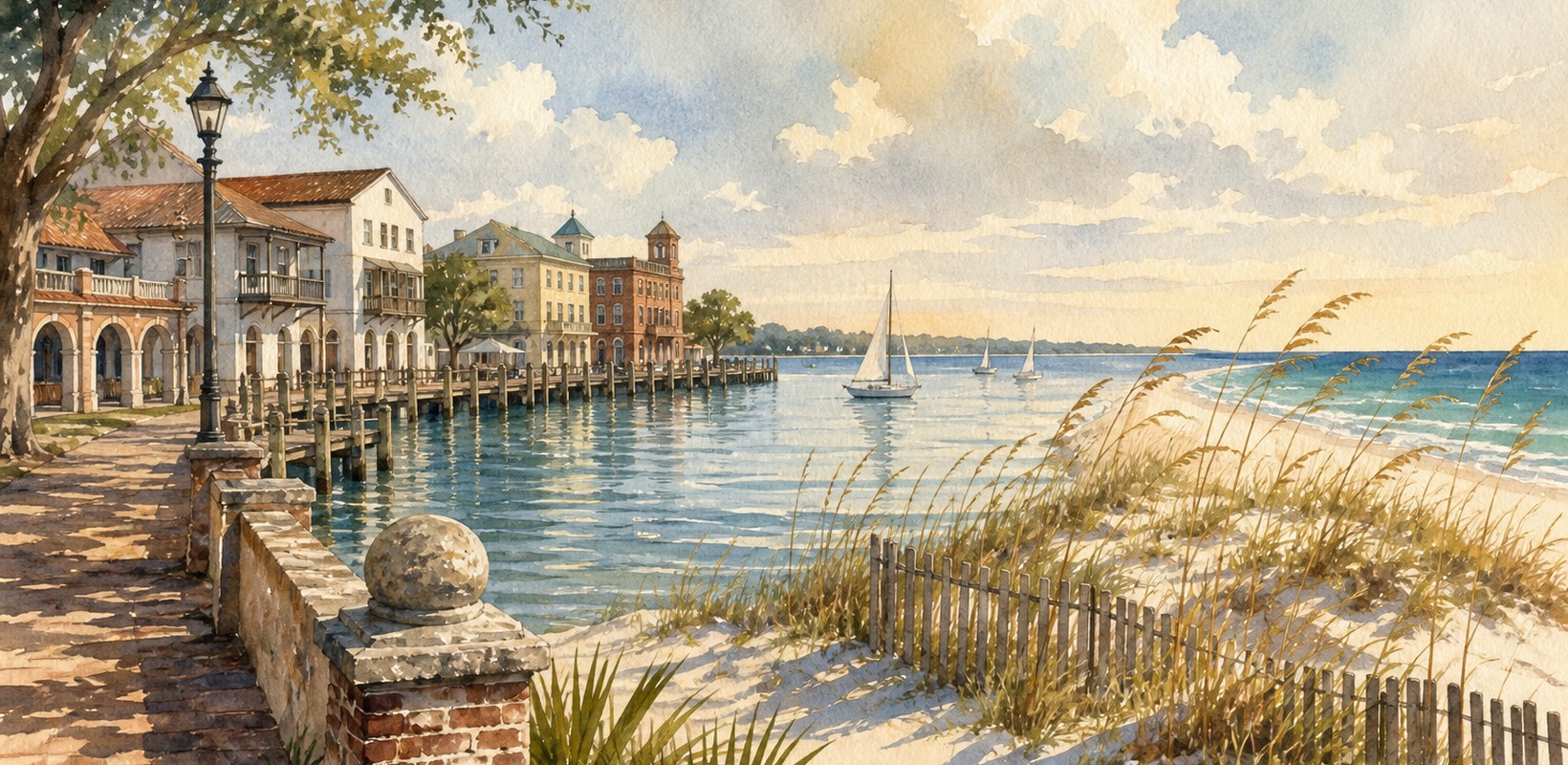
Pensacola's history begins with an ambitious arrival and a badly timed hurricane. In 1559, Tristán de Luna brought a Spanish expedition to Pensacola Bay intending to establish a colony. Before most supplies had been unloaded, a hurricane wrecked or grounded much of the fleet. The settlement was abandoned within two years. Spain returned permanently in 1698, and the city later lived under Spanish, French, British, Confederate and United States flags, earning its familiar City of Five Flags nickname.
Pensacola is the Escambia County seat and the region's cultural and economic center. Its downtown, historic districts and bayfront lead west and north into a large unincorporated urban area that includes Warrington, Myrtle Grove, Bellview, Ensley and Ferry Pass. Pensacola Beach lies on Santa Rosa Island but remains unincorporated Escambia County. Century, near the Alabama line, is the county's other incorporated town. Perdido Key forms the southwestern coastal edge, with beaches and protected lands facing the Gulf.
Naval Air Station Pensacola and the wider military community have shaped the area for generations. The port, health care, tourism and education add other layers. The county's geography ranges from barrier island to older city blocks, suburban neighborhoods, farms and pine country. Property values and development patterns vary sharply over that distance, and a deed must describe the specific parcel rather than the general community name people use.
Escambia also has one of Florida's deepest accessible land-record histories. The clerk's Official Records page links a historical deed-book index covering 1820 through 1982. Those books reach back to the year before Florida formally became a United States territory. For researchers, an old family name or book-and-page reference can open a window into nearly two centuries of local land transfers. Current online systems are faster, but the old indexes give the chain of title its long memory.
A modern deed may transfer a Pensacola bungalow, a Pensacola Beach leasehold interest, a Century parcel, a condominium, suburban home or rural acreage. Common reasons include a sale, gift, trust transfer, estate plan, marriage-related change, business transaction or correction. Coastal and condominium property may have additional recorded restrictions and interests, while older city lots can carry descriptions built from historic plats. The deed should be chosen and prepared for the actual transaction before it reaches the recorder.
The Escambia County Clerk of the Circuit Court and Comptroller records deeds and other instruments in the Official Records. The Official Records and Recording office is at 221 Palafox Place, Suite 110, in Pensacola, a different address from the clerk's main courthouse listing. Documents can be submitted in person, by mail or through approved eRecording vendors. The clerk lists CSC, Simplifile and ePN and explains that deeds are among the documents commonly accepted electronically.
Standard recording is generally $10 for the first page and $8.50 for each additional page, plus $1 for every indexed name over four. Documentary stamp tax on deeds is generally $0.70 per $100 of consideration outside Miami-Dade County. Escambia provides an online fee calculator because the complete total depends on consideration, number of pages and indexed parties. Current office hours are slightly shorter for Official Records than for the main clerk office, another detail worth checking before a trip.
The Escambia County Property Appraiser's site helps identify the owner, parcel number, assessed value and map. The clerk's Official Records search supplies deeds and related instruments. Use both, and be cautious about assuming a Pensacola mailing address means the parcel is inside Pensacola city limits. Municipal status can affect local government questions even though the county recording office is the same.
Escambia County has survived storms, changed flags and accumulated land records since Florida's territorial era. A new deed becomes a very small part of that long archive. Getting the legal description, signatures, taxes and recording destination right ensures that it is also a useful part.
Official Records
Where deeds are recorded in Escambia County
| Detail | Recording information |
|---|---|
| Recording authority | Escambia County Clerk of the Circuit Court and Comptroller |
| Department | Official Records / Recording |
| Main recording office | 221 Palafox Place, Suite 110, Pensacola, FL 32502 |
| Mailing address | Official Records, 221 Palafox Place, Suite 110, Pensacola, FL 32502 |
| Telephone | 850-595-3930 |
| Submission | In person, by mail, or by eRecording through approved vendors including CSC, Simplifile and ePN. |
| Standard charges | For a standard letter-size instrument, Florida's statutory charges generally total $10 for the first page, $8.50 for each additional page, plus $1 for each indexed name after the first four. Deed documentary stamp tax is generally $0.70 per $100 or part of $100 of consideration. Tax, extra documents, certified copies and vendor charges can change the total. |
| Official Records | Search recorded documents |
| Property records | Open the county property appraiser |
Preparing the instrument
Deed requirements for Escambia County
Florida law generally requires a deed conveying real property to be signed by the grantor in the presence of two subscribing witnesses. The instrument also needs the parties, legal description, consideration and documentary stamp treatment, acknowledgment, preparer information, return address, and printed witness information required for the particular recording.
For Escambia County, the recorder currently describes submission this way: In person, by mail, or by eRecording through approved vendors including CSC, Simplifile and ePN. Posted standard charges are: For a standard letter-size instrument, Florida's statutory charges generally total $10 for the first page, $8.50 for each additional page, plus $1 for each indexed name after the first four. Deed documentary stamp tax is generally $0.70 per $100 or part of $100 of consideration. Tax, extra documents, certified copies and vendor charges can change the total.
The clerk records documents that satisfy its intake requirements but does not decide whether a deed produces the intended ownership, homestead, tax, mortgage, or estate-planning result. Review the current deed and transfer plan before signing. See Florida Statutes section 689.01 (opens in a new tab) for the statewide conveyance rule.
Recording places a deed in the county's public records, but it does not replace attorney review of the deed, title, homestead, tax or signing issues.
Sources and verification
- Escambia County Official RecordsOfficial Records services, historical deed-book index, recording office address, telephone number and fee calculator.
- Escambia eRecording InformationApproved electronic-recording providers and commonly eRecorded documents.
- City of Pensacola Port Facts1559 de Luna arrival, hurricane destruction and permanent 1698 settlement.
- NPS De Luna ExpeditionExpedition purpose, Pensacola Bay site and 1559 hurricane.
- City of Pensacola About Our CityFive Flags identity and local history.
- Escambia County Property AppraiserOfficial parcel, ownership and assessment information.
- Florida Statute 28.24, clerk recording chargesState recording charge framework.
- Florida Department of Revenue, Documentary Stamp TaxDeed tax rates and Miami-Dade distinction.
General information only. This article is not a substitute for legal advice about a particular property or transfer.